Pattern, Tessellation and Symmetry
How a single motif, repeated by simple rules, can cover a wall, a fabric or a whole floor.
Pattern, Tessellation and Symmetry
Walls that seem to go on forever
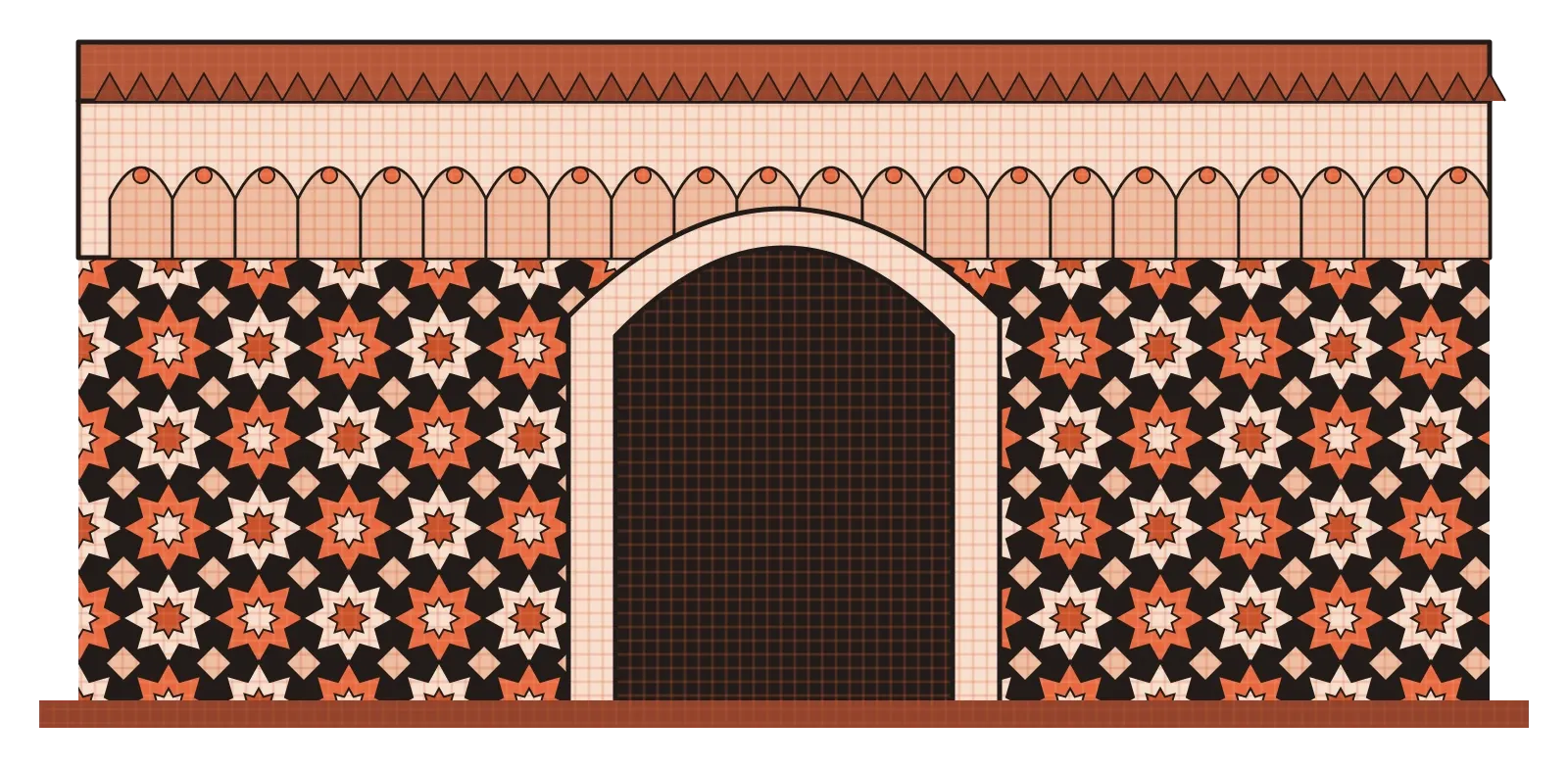
The Alhambra, a palace and fortress complex in Granada in southern Spain, was built and expanded mostly in the thirteenth and fourteenth centuries by the Nasrid rulers, the last Muslim dynasty in that part of Europe. Walk through its courtyards and halls and you're surrounded by pattern. The lower walls are covered in glazed tiles arranged into interlocking stars, polygons and woven bands. Above them, carved plaster spreads into lacy geometric and plant-like designs, and the ceilings break into intricate honeycomb vaults. Everywhere you look, a small set of shapes repeats, rotates and reflects, filling every surface without gaps and somehow never feeling chaotic.
The Alhambra has a special place in the history of design partly because of who visited it. The Dutch artist M. C. Escher, whose bird-and-fish woodcut I mentioned in the post on figure and ground, travelled there in 1922 and again in 1936, sketching the tile patterns carefully. Those visits pushed him towards his life's work of interlocking shapes. Mathematicians love the Alhambra too, and you'll often read that its walls contain examples of all seventeen possible types of repeating flat pattern. That claim is actually disputed. Some researchers have found all seventeen, others count fewer depending on how strictly they define each type. Either way, the palace shows something designers can learn from: with a few simple shapes and a few simple rules about how to repeat them, you can create patterns of astonishing richness. This post is about those rules.
A motif and a rule for repeating it
Every pattern is made of two things. The first is the motif, the basic unit that repeats. It might be a flower, a star, a dot, a stripe or an abstract shape. The second is the repeat, the rule that decides how the motif is copied across a surface. Change the motif and the pattern looks different. Keep the motif but change the rule, and it can look completely different again. In the post on rhythm and repetition, I wrote about how repeated elements create movement and unity. Pattern is what happens when that repetition spreads in two directions at once, across and down, to cover an entire surface.
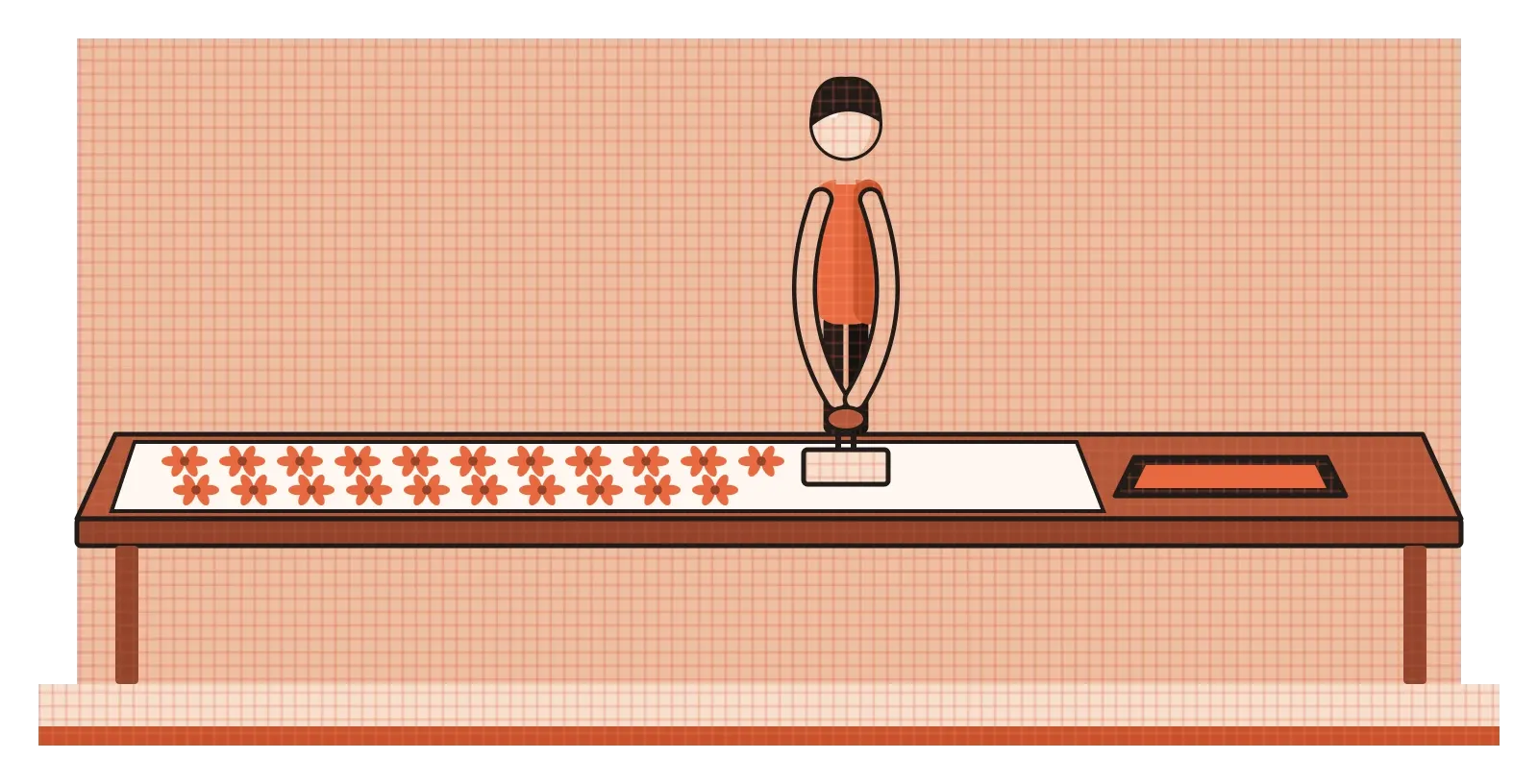
India has some of the world's most skilled traditions of pattern-making, and block printing shows the motif-and-repeat idea very directly. In towns like Bagru and Sanganer near Jaipur, and in the Kutch region of Gujarat, printers carve a motif into a block of wood. They dip the block in dye and press it onto cloth, then lift it, line it up carefully next to the last print and press again, over and over, until the fabric is covered. Ajrakh, a traditional block-printed textile from Kutch and Sindh, is known for its dense geometric and floral repeats in deep indigo and madder red, often printed in several stages with different blocks lining up perfectly on top of each other. The motif lives in the carved block. The repeat lives in the printer's hands and eyes, judging exactly where each new impression should land.
Designers still talk about repeat types in much the same way. A straight repeat, sometimes called a block or grid repeat, places the motif in neat rows and columns. A half-drop repeat shifts every other column down by half the height of the motif, which hides the grid and makes the pattern feel more organic. A brick repeat does the same sideways, like bricks in a wall. A mirror repeat flips the motif to create symmetrical pairs. Each choice changes the rhythm of the whole surface, even when the motif itself stays the same.
Four simple moves behind every pattern
In the post on balance, I wrote about symmetry as a mirror image down the middle of a design. In pattern-making, symmetry is a broader idea. It means any way of moving a motif so that the pattern still looks the same afterwards. Mathematicians describe four basic moves. The first is translation, sliding the motif along without turning or flipping it, the way a block printer moves the block across the cloth. The second is reflection, flipping the motif over a line to make its mirror image. The third is rotation, turning the motif around a point, by a quarter, a third or half a turn, for example. The fourth is glide reflection, which combines a reflection with a slide, like a line of footprints, where each left foot is a mirrored and shifted version of the right.
What's remarkable is that if you want to cover a flat surface with a pattern that repeats in two directions, there are only a limited number of ways to combine these moves. In 1891, the Russian crystallographer Evgraf Fedorov proved that there are exactly seventeen distinct types, now usually called the seventeen wallpaper groups. Every repeating flat pattern ever made, whether it's a tiled floor, a saree border extended across a whole fabric, a wallpaper or a phone background, belongs to one of these seventeen families. The motifs can be endlessly different, but the underlying structures can't.
I find that a reassuring idea for designers. It means pattern isn't a mysterious talent that some people simply have. It's a structure you can learn. Once you start noticing which moves a pattern is using, whether a motif is only sliding, or also flipping and turning, you can analyse almost any pattern you see and start making your own on purpose, instead of by trial and error. You don't need to memorise the seventeen groups. Just knowing that the four moves exist gives you a powerful set of tools.
Tessellation: shapes that fit with no gaps
A tessellation is a special kind of pattern where shapes fit together perfectly, covering a surface with no gaps and no overlaps, like tiles on a floor. Not every shape can do this. Among regular polygons, the ones with all sides and angles equal, only three can tessellate on their own: the equilateral triangle, the square and the regular hexagon. Try it with regular pentagons and you'll always end up with awkward gaps. That's why so many floors are covered in squares and so many bathroom walls in hexagons. The geometry simply works.
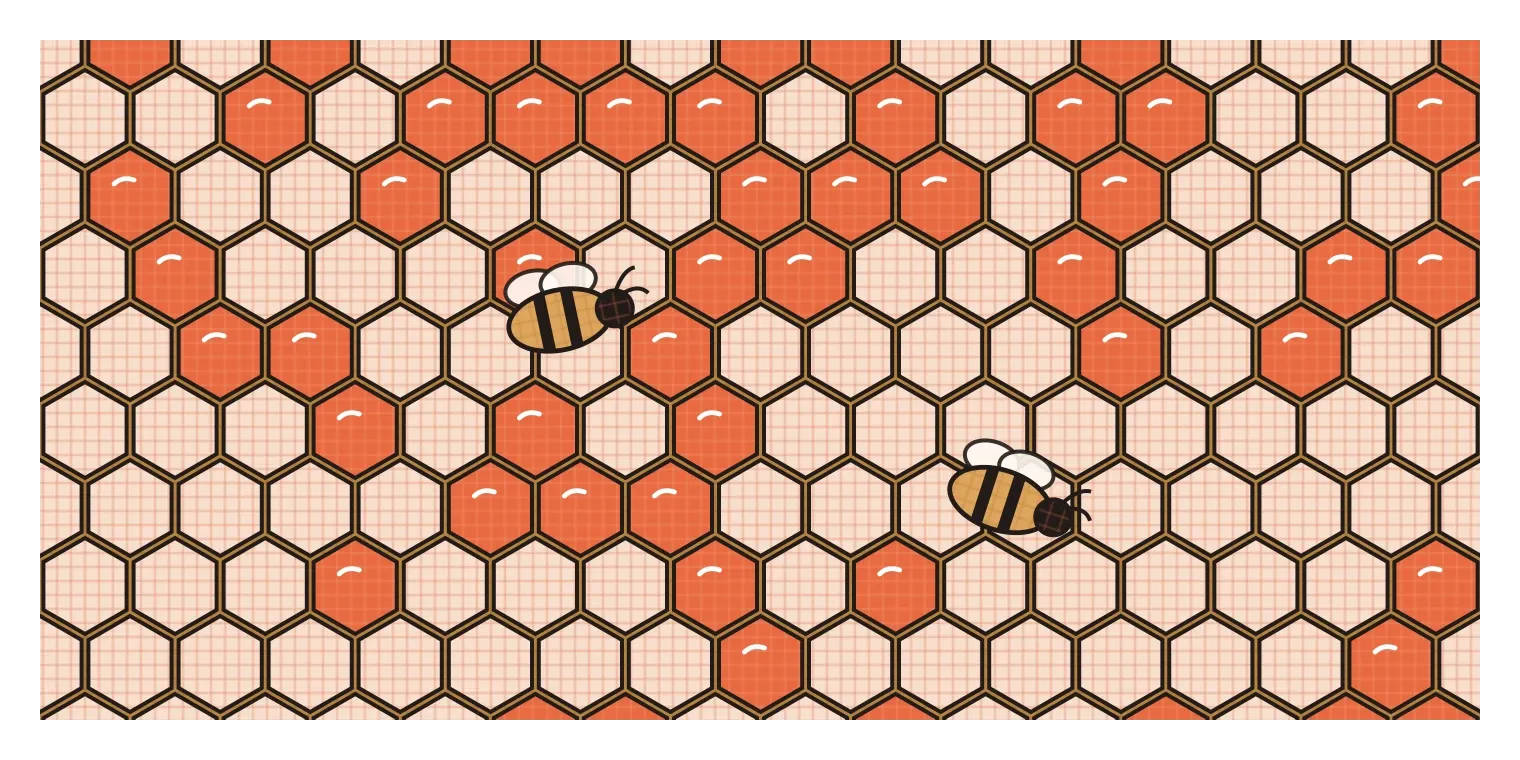
Bees seem to have discovered this long before we did. A honeycomb is made of hexagonal cells, packed tightly side by side. For centuries, people suspected that hexagons were the most efficient way to divide a surface into equal cells using the least amount of wall, which for bees means the least wax. This idea, known as the honeycomb conjecture, was finally proved mathematically by Thomas Hales in 1999. Nature often finds the efficient answer first, and designers end up borrowing it.
Tessellation can also be playful. Escher realised that if you start with a simple tessellating shape, like a square or a hexagon, and then carefully change one edge while making the matching change on the opposite edge, the new shapes will still fit together perfectly. By doing this again and again, he turned plain polygons into interlocking birds, fish, lizards and horsemen, a practice he called the regular division of the plane. Closer to home, the handmade Athangudi tiles of the Chettinad region in Tamil Nadu show how a single square tile, decorated with part of a design, can combine with its neighbours to form larger flowers, stars and borders across a whole floor. Each tile is simple. The pattern only appears when they come together.
Patterns that never quite repeat
For a long time, people assumed that any pattern covering a surface in an orderly way had to repeat at regular intervals. Then, in the 1970s, the British mathematician and physicist Roger Penrose found sets of tiles that could cover a flat surface completely, with no gaps, but in a way that never repeats exactly, no matter how far you extend it. His best-known set uses just two shapes, often drawn as a fat and a thin rhombus. The patterns they make are clearly ordered, full of five-pointed stars and ten-sided flowers, yet you can never slide the whole pattern along and have it land exactly on itself. These are called aperiodic tilings, and for a while they seemed like a purely mathematical curiosity.
They turned out to matter in the real world. In 1982, the Israeli materials scientist Dan Shechtman discovered a metal alloy whose atoms were arranged in a similar ordered but non-repeating structure, which many scientists at first refused to believe was possible. These materials are now called quasicrystals, and Shechtman won the Nobel Prize in Chemistry in 2011 for discovering them.
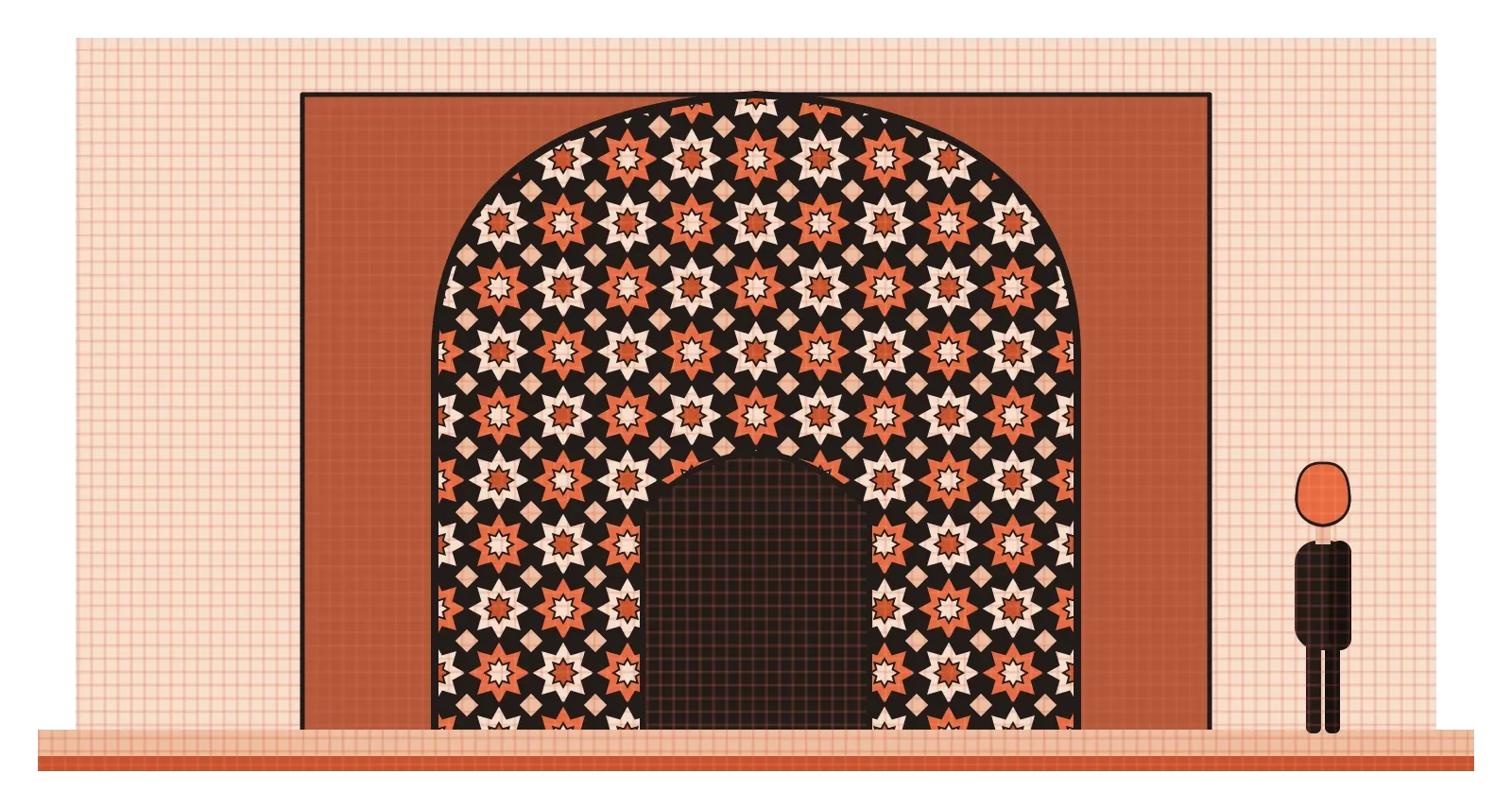
The most surprising twist came from history. In 2007, the physicists Peter Lu and Paul Steinhardt published a paper in the journal Science about girih, the star-and-polygon patterns used in Islamic architecture. They showed that from around the thirteenth century, craftsmen seem to have used a small set of decorated tile shapes to create complex patterns, and that some later designs, such as the tilework on the Darb-i Imam shrine in Isfahan, Iran, built in 1453, come remarkably close to the kind of non-repeating order Penrose described, centuries before Western mathematics caught up. It's a humbling reminder that pattern-makers and craftspeople were exploring deep mathematical ideas with their hands long before anyone wrote them down as theory.
Learn the moves, then make your own
Pattern sits at a lovely meeting point between craft, art and mathematics. A printer in Bagru, a tile-maker in Chettinad, a craftsman in fifteenth-century Isfahan, an artist like Escher and a mathematician like Penrose are all, in different ways, working with the same few ideas: a motif, a rule for repeating it and a sense of how shapes fit together. Understanding those ideas doesn't take anything away from the beauty of a pattern. If anything, it makes the skill behind it even more impressive.
For designers, patterns show up everywhere: textiles, packaging, wallpapers, tiles, brand backgrounds, app illustrations and even the subtle textures behind interfaces. A few habits make them easier to work with. Start with a simple motif and test it in different repeats, straight, half-drop, brick and mirrored, before adding more detail, because the repeat often matters more than the motif. Zoom out regularly to see the pattern as a whole surface, not just a single tile, since unexpected lines and clusters often appear only at a distance. Check the edges where repeats meet, which is where most mistakes hide. And think about scale: the same pattern can feel calm and textured when small, or bold and graphic when large.
The Alhambra's walls have been drawing people in for more than six hundred years, and they still reward close attention. The longer you look, the more you notice how each shape has been rotated, reflected or shifted to make the next. That's the real pleasure of pattern. It's built from simple pieces and simple rules, but when those rules are chosen with care, the result can feel endless.
Further reading: Peter J. Lu and Paul J. Steinhardt, "Decagonal and Quasi-Crystalline Tilings in Medieval Islamic Architecture" (2007) · Doris Schattschneider, M. C. Escher: Visions of Symmetry (1990) · Owen Jones, The Grammar of Ornament (1856)