Design, Art, Craft
Three words that were once one, and still refuse to stay apart.
Design, Art, Craft
A museum once put a ball bearing on a pedestal
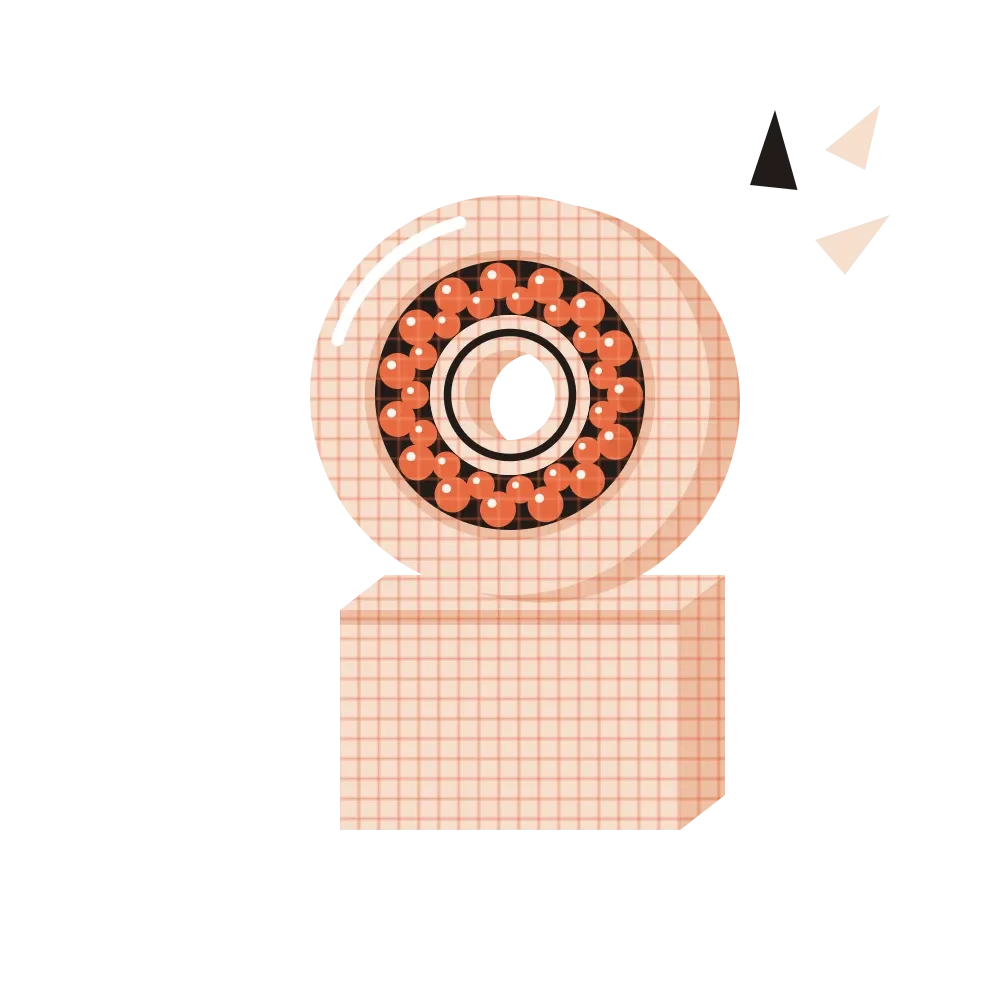
In 1934, the Museum of Modern Art in New York opened a show called Machine Art, and the object it chose for the catalogue cover was a ball bearing. If you have never held one, it is the small steel ring with balls inside that lets a shaft spin without grinding itself to dust. This one was made by SKF, a Swedish company, and the engineers behind it were thinking about friction and load, not beauty. Inside the galleries it had company: springs, saucepans, propellers and cash registers, all lit like sculptures. I like to imagine someone from the SKF factory walking in and finding their work part on a plinth, being admired by people in hats.
The question I can't let go of is what that bearing actually was. Someone planned it to solve a problem, which sounds like design. A museum chose to frame it as something worth contemplating, which sounds like art. And someone had to understand steel well enough to make it almost perfectly round, which sounds a lot like craft. Anyone who has worked as a designer has had a version of this argument, usually without calling it that. A stakeholder says a screen is "too artsy", a developer says a detail is "just decoration", or a client asks for something "creative" and then rejects anything that is. Underneath all of it are three words we use as if they were separate boxes: design, art and craft. They were never that separate, and the story of how they drifted apart explains a surprising amount about the job we do today.

For most of history, nobody bothered to separate them
The ancient Greeks had one word for all of it: techne, which roughly means skilled making. A sculptor had techne, and so did a shipbuilder, a doctor and the person who made your sandals. Nobody thought the sculptor was operating on a higher plane. He just had a different material and a different client. The Romans translated the idea as ars, which is where our word "art" comes from, although for them it still meant skill rather than paintings in a gallery with a wine-and-cheese opening.
That way of thinking lasted a long time. In medieval Europe, painting and sculpture were manual trades, much like carpentry or weaving. In Florence in the 1300s, painters didn't even have a guild of their own. They were enrolled in the guild of doctors and pharmacists, partly because they bought their pigments from the same shops that sold medicines. So on paper, Giotto, one of the painters who changed Western art, sat closer to the local chemist than to any philosopher. India had a similar outlook. The Sanskrit word shilpa covered any skilled art or craft, and the old technical texts called the Shilpa Shastras dealt with temple building, sculpture, furniture and even town planning as parts of one body of knowledge. There was no ranking that put the sculptor above the carpenter.
The word that matters most for designers came out of Renaissance Italy. Disegno meant drawing, but it also meant the idea in your head that a drawing makes visible. Giorgio Vasari, a painter who also wrote the first big book of artists' biographies, argued that disegno was the root of painting, sculpture and architecture, and in 1563 he helped found an academy in Florence around that belief. Reading about it now, I find it a very relatable move. The painters were essentially saying that their work starts in the mind, not the hands, so please stop treating them like tradespeople. They wanted a seat closer to scholars and princes. Our English word "design" grew out of disegno, and it still carries both of its meanings, a plan in someone's head and a pattern on a surface.
Then art got promoted and the factory split the rest
The family broke up in two stages, and art left first. In 1746, a French writer called Charles Batteux grouped music, poetry, painting, sculpture and dance together and named them the "fine arts". Their purpose, he said, was pleasure, and anything useful stayed outside the club. It sounds like a small piece of filing, but it changed how people thought. Before the 1700s, nobody would have put a song and a fresco in one category and a beautifully made sword in another. Our idea of "the arts" as a special family is only about 280 years old. A few decades later, the German philosopher Immanuel Kant added that true beauty is enjoyed for its own sake, not for what it does. I'll admit that as a designer, this one stings. By Kant's logic, the moment something becomes useful, it quietly loses its invitation.
The second stage came with the factory. Around the same time, the English potter Josiah Wedgwood reorganised how pots were made at his works in Staffordshire, which opened in 1769. Making a single pot was broken down into many small tasks done by different workers, and the shape and decoration were decided in advance, sometimes by a sculptor he hired for the purpose. For the first time, the person who imagined an object and the people who made it were completely different people, working in different rooms for different wages. The design historian Adrian Forty has argued that this is where the designer was born as a job. When I read that, it made a lot of sense to me. Design, as a profession, is basically what you get when someone separates the thinking from the making and pays one person for the thinking.
The old all-round maker ended up with a smaller label. "Craft" comes from the Old English cræft, which simply meant strength or skill. Once machines could make things faster and cheaper, the word narrowed to mean making by hand, in small numbers, often in a traditional way. Craft became whatever industry wasn't. By the middle of the 1800s the three siblings had moved into different houses. Art had the gallery, design had the factory and its new government schools for training pattern-drawers, and craft had the workshop, along with a nagging feeling of being left behind.

I stopped looking for definitions and started asking questions
Every neat definition of art, design or craft seems to have a famous exception waiting to break it, so I find it more useful to ask a few questions about the work itself. The first is whose question the work is answering. Art usually answers a question the artist asked. Nobody told Van Gogh to paint wheat fields the way he did; he was working something out for himself. Design answers someone else's question, whether that is a client who needs a logo, a city that needs signs people can read, or a user who wants to book a ticket without getting lost. Charles Eames, one of the best-known designers of the last century, was once asked whether design was a kind of art. He said he would rather call it an expression of purpose, and that if it was good enough, people might later judge it as art. Purpose comes first, and art, if it comes at all, comes later.
The second question is where the value of the work lives. In art, it lives mostly in meaning, in what the work makes you see, feel or question. In design, it lives in the fit between the thing and the people using it, which is why a beautiful logo for the wrong company is still a bad design. In craft, the value lives in the making: the skill, the feel for the material, the sense that a careful hand was involved. The furniture maker David Pye described this well in 1968. He said some work is done with risk, where the result depends on the maker's care at every moment, like a potter at the wheel, while other work is done with certainty, where a mould or a machine fixes the result in advance, like a plastic bottle. Craft lives on the risky side of that line.
The third question, and the one I think gets overlooked, is what counts as failure. A painting that confuses most people can still be a masterpiece. A medicine label that confuses most people has failed, and someone could get hurt. A handmade bowl that cracks in the kiln has failed as craft, however lovely its shape. Each discipline is judged against a different standard: art against its own ambition, design against the people who use it, and craft against the quality of the making.
The easiest place to test all this is a roadside chai stall. The small ridged glass your tea comes in was designed by someone who settled its thickness, its weight, how it stacks and how you hold it when it's too hot, and then a factory made thousands of them. The clay kulhad next to it is a different story. Nobody knows who first arrived at its shape, but every single one was made by a potter's hands. Neither of them is art. Then again, put either one on a white stand in a gallery with a spotlight and a small title card, and I promise someone will start a very long conversation about it.
Some people tried to put the family back together
A few of my favourite stories in design history are about people who tried to reunite the three, and the honest part is that none of them fully managed it. William Morris was one of the first. Victorian factories were pumping out cheap goods smothered in decoration, and Morris couldn't stand them. He believed ordinary objects deserved the same care as art, and in an 1880 lecture he gave the advice that now lives on half the home-decor boards on the internet: "Have nothing in your houses that you do not know to be useful, or believe to be beautiful." His workshops made wallpaper, fabric and furniture by hand, and the Arts and Crafts movement grew up around his ideas. The catch, which Morris knew perfectly well, was price. Handmade things were expensive, so the working people he cared about, as a committed socialist, couldn't afford what his own workshops made. Craft could make objects beautiful, but it couldn't make them available to everyone. That needed factories, and factories needed designers.
The Bauhaus tried to go further and bring all three under one roof. When the architect Walter Gropius opened the school in Germany in 1919, his founding statement sounded a lot like Morris. Artists and craftsmen, he wrote, were essentially the same thing, and students trained in workshops under both an artist and a master craftsman. Within four years the focus had shifted towards making prototypes that factories could reproduce. My favourite detail from this period is a small teapot by Marianne Brandt from 1924. It is all circles and half-spheres and looks as if a machine stamped it out, but it was actually made by hand, because industry wasn't ready to produce it yet. So the look we now call machine-age was, at least at first, built by craftspeople.
Marcel Duchamp came at it from the opposite direction. In 1917 he bought an ordinary factory-made urinal, laid it on its back, signed it with a made-up name and sent it to an exhibition in New York under the title Fountain. The organisers refused to show it, and the original was later lost. Even so, in 2004 a poll of 500 art experts in Britain voted it the most influential modern artwork ever made. An anonymously designed bathroom fixture became art because an artist chose it and gave it a name. Museums have kept doing versions of this ever since. MoMA's collection now includes the @ symbol and video games like Pac-Man and Tetris, which means our ball bearing from 1934 is in fairly fun company. Whether something counts as art seems to depend at least as much on where we stand when we look at it as on the object itself.
The European story isn't the only one, and in India it isn't even the most useful one
Most of what design school teaches about this comes from Europe, and it's easy to take that for granted. But if you design in India, the European version leaves a lot out. Ananda Coomaraswamy, a Sri Lankan-born scholar who spent years as a curator at the Museum of Fine Arts in Boston, argued that the split between fine art and useful craft was a modern Western habit, not a universal truth. In traditional Indian life, he pointed out, the person carving a temple image and the person shaping a cooking pot were both simply skilled makers working towards a purpose. He put it in a line that has stayed with me: "The artist is not a special kind of man, but every man is a special kind of artist."
The lota is probably the best example of what he meant. It's the round brass or copper water pot that most of us have seen in a grandparent's house, and nobody knows who designed it. Its shape was refined over generations of daily use until it became easy to fill, easy to pour from, comfortable to carry and pleasant to look at on a shelf. When Charles and Ray Eames toured India in 1958 to advise the government on design education, they wrote a report that led to the founding of the National Institute of Design in Ahmedabad in 1961. In it, they praised the lota as one of the finest objects ever made. I love that two of the most famous designers in the world held up an anonymous household pot as a model of good design.
After Independence, craft in India was never a hobby. It was how millions of people earned a living. Kamaladevi Chattopadhyay, a freedom fighter who went on to lead the All India Handicrafts Board, treated the revival of crafts as a way to protect jobs and skills, not as a nostalgic project. For her, craft was nobody's poor cousin. It was part of how a new country would stand on its own feet.
This leaves designers like me with a question that I don't think has a comfortable answer. Take the lacquered wooden toys of Channapatna in Karnataka, and imagine a design studio partnering with the artisans there on a new range for city stores. Who is the designer in that story? Usually the studio gets the credit and most of the money, even though the artisans bring generations of skill that make each toy what it is. Calling one group "designers" and the other "makers" quietly decides who gets paid for thinking. In India especially, the line between design and craft often has less to do with the work and more to do with class and credit, and I think we should be more honest about that.
Why I still think the three words are worth keeping
If the lines are this blurry, it's fair to ask why we should keep the labels at all. My answer is that each word protects something the other two tend to forget. Art protects the freedom to ask questions nobody asked for. Design protects the person on the other end, the one using your app at two in the morning with a crying baby and one bar of signal. Craft protects the knowledge that lives in hands and materials, the kind you can never fully write into a brief or a ticket.
In day-to-day work, this turns into a simple habit. While you're working on something, it helps to notice which of the three you're being asked for and which one you're drifting towards. If every brief turns into a personal art project, the people who have to use the thing will feel it. If craft gets forgotten, the work looks great in the review and feels cheap the moment someone actually holds it or taps through it. And if art disappears completely, nobody stops to ask whether the brief was even the right question. Most of the projects I've seen go wrong went wrong in one of those three ways.
The ball bearing on its pedestal in 1934 was all three at once. It was designed to solve a real problem, crafted with a precision most hands could never reach, and turned into art by a room full of people who finally stopped to look at it properly. I think most good work is like that, which is why I've stopped treating design, art and craft as boxes. They work much better as three different ways of looking at the same thing, and the designers I admire most can switch between them without making a fuss about it.
Further reading: Adrian Forty, Objects of Desire (1986) · David Pye, The Nature and Art of Workmanship (1968) · Richard Sennett, The Craftsman (2008) · Charles and Ray Eames, The India Report (1958).